Thinking of turning your love of green spaces and outdoor design into a business in Oregon? Great choice. But before you dig spades into the soil, it’s important to know that landscaping construction (installing new lawns, patios, irrigation, retaining walls, etc.) in Oregon is regulated, and not all “yard work” counts the same.
In this article, we’ll walk you through what kinds of licensing you’ll need, what steps you’ll take, and what insurance and business-registration matters you should keep in mind , so you can plant the seeds of your business on firm legal ground.
1. Licensing Requirements for Landscaping Business in Oregon:
a. Landscape Construction Professional License (Individual)
In the state of Oregon, you’ll actually need two different licenses if you’re going to do full landscaping construction work:
- One for the individual who supervises the work: The Oregon Landscape Contractors Board (LCB) calls this the Landscape Construction Professional (LCP) license.
- Another for the business entity that signs contracts, carries insurance and bonds, etc.
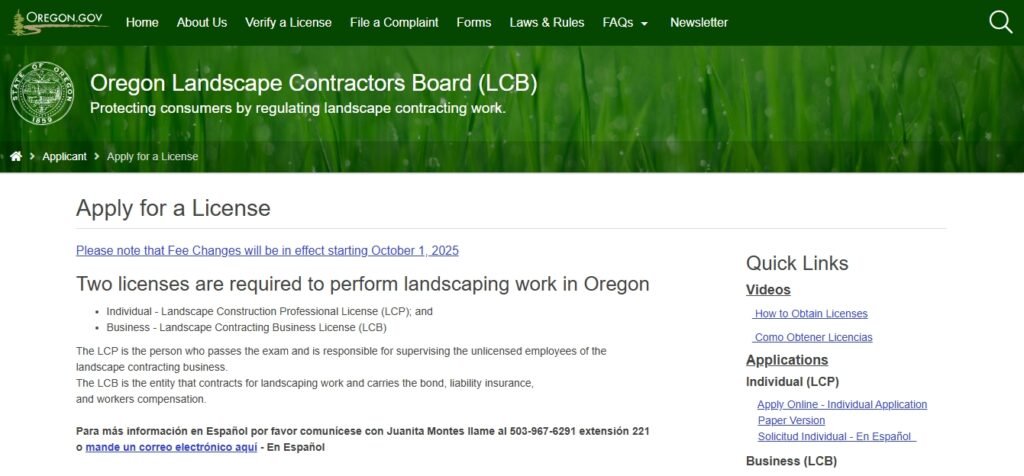
Visit Oregon Landscape Contractors Board (LCB) for more information regarding licenses.
Here are key features of the individual license:
- The LCP is the person who passes the exam and will supervise any unlicensed employees of the landscaping business.
For the required steps, follow Oregon Landscape Contractors Board (LCB): Steps to Becoming Licensed.
- You must submit an application, pay a fee, and then, once approved, you’ll get an ID and schedule for the exam via the LCB.
Example of statutory requirement: According to Oregon Revised Statutes (ORS 671.530), you may not operate as a landscape construction professional unless you have a valid license.
Here are some Licensing Requirements you need to know before pitching your business officially.
Fee details: For example, as of 2025, the initial fee for an LCP license is $200.
b. Pesticide Applicator License
If your landscaping services include pest control, spraying for weeds, insects, or fungi, you’ll need a Commercial Pesticide Applicator License from the Oregon Department of Agriculture (ODA).
Who Needs It:
- Landscapers applying any pesticide or herbicide on a client’s property for payment.
- Supervisors overseeing pesticide applications.
Here are the Requirements:
- Pass two exams:
- Core Exam (general pesticide safety and regulations).
- Category Exam (specific to ornamental and turf management).
- Attend pesticide safety training sessions as required.
- Pay licensing fees (around $70–$100 for most categories).
- Renew the license every five years with proof of continuing education.
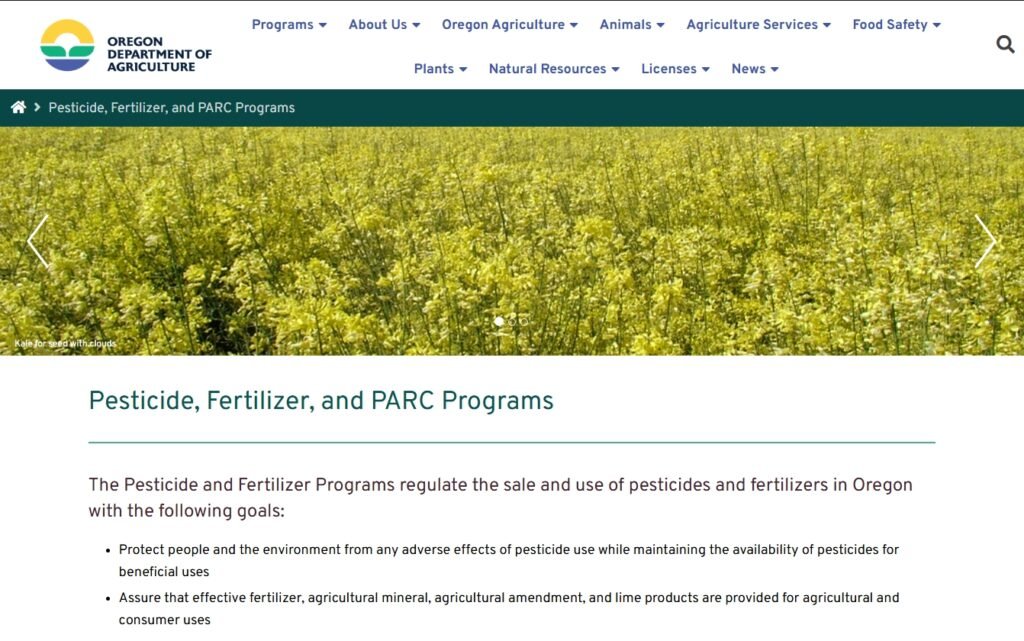
Visit the official website of the Oregon Department of Agriculture for more information regarding Oregon Pesticide Licensing.
Tip: Even if your company hires a subcontractor for pest control, ensure they’re licensed — using unlicensed applicators can result in fines from the ODA.
c. Nursery or Plant Dealer License
If your landscaping business also sells or distributes plants, shrubs, trees, or sod, you’ll need a Nursery or Plant Dealer License from the Oregon Department of Agriculture.
d. Nursery Dealer License
Required if your business sells live plants or nursery stock (such as trees, flowers, or turf) directly to customers.
Here are the steps:
- Apply through the Oregon Nursery Dealer Licensing Portal.
- Submit details of your nursery or garden center.
- Pay the fee (around $150–$250, depending on business size).
- Comply with inspection and plant health regulations.
e. Nurseryman License
If you grow and propagate plants yourself (instead of reselling), you’ll need a Nurseryman License.
Here are the steps:
- Apply online at the ODA Nursery Program.
- Allow for site inspection and pest compliance check.
- Pay an annual fee based on nursery acreage or sales volume.
These licenses protect consumers by ensuring plants sold in Oregon are pest-free and healthy.
f. Landscape Contracting Business License (Business)
Once the individual is licensed (or will be licensed), the business itself must also carry a license if it is entering into contracting work (installations, etc.). Here’s what you’ll need to know:
The business license covers the entity that contracts for landscaping work, holds the bond, insurance, and is the contracting party with clients.
Steps to get this license:
- Set up your business entity and decide whether you’ll be a sole proprietor, LLC, corporation, etc. (talking to an attorney or accountant is recommended).
- Register the business name / assumed business name with the Oregon Secretary of State.
- Obtain liability insurance (and workers’ compensation if you have employees). For example, liability insurance must be at least $500,000, and the LCB must be listed on the certificate.
- Obtain a surety bond appropriate for the volume/phase of your business. For example, bond amounts vary between $3,000 and $20,000 depending on the work.
- Submit the business application to the LCB with all documentation (insurance certificate, bond form, business entity documentation). Allow approximately 10 business days for processing.
Fee detail: As of October 1, 2025, the business license initial fee is $375.
g. Other license phases / categories
There is a “modified license” phase in Oregon for smaller-scale landscaping work (for example, limited value jobs, simplified scope). For example, a blog notes that the “modified license” allows up to around $5,000 of landscaping work in certain categories.
Note that Landscape Contractors in Oregon Can Now Obtain A Modified License.
Also, keep in mind the distinction: Full “landscape construction” (new installs, irrigation, retaining walls, etc.) vs. simple “maintenance” (mowing, pruning, edging). Interestingly, landscape maintenance alone is not regulated by the state in terms of this license.
Here’s the pdf of General Information for a landscape construction professional exam and license.
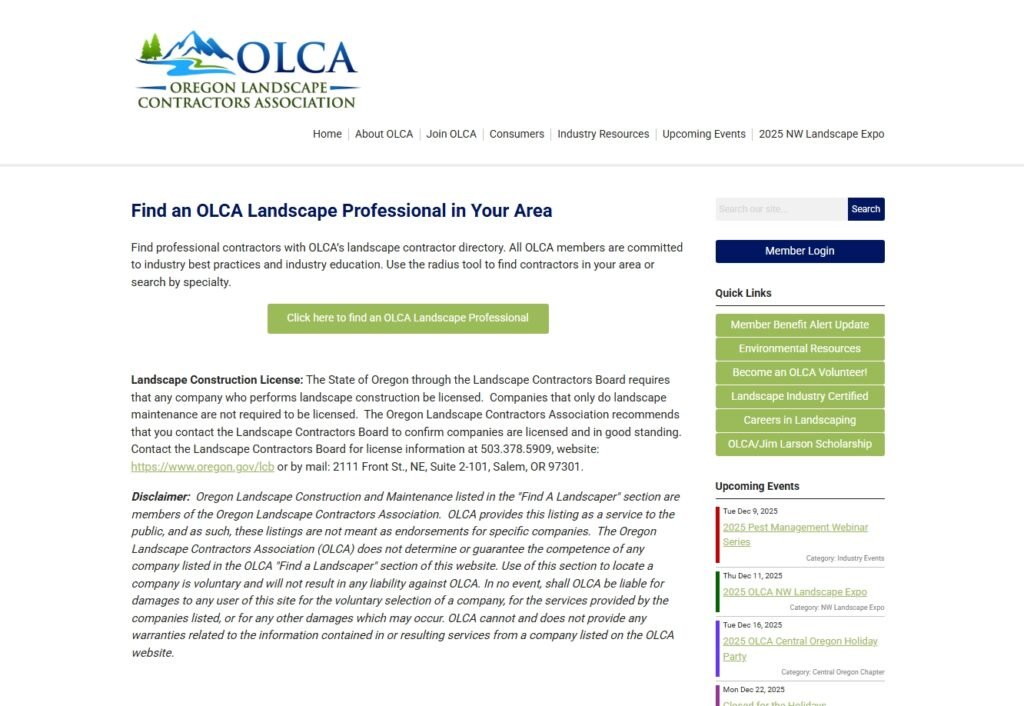
Find a Professional Landscaper through the Oregon Landscape Professional Association (OLCA).
2. Application & Timeline:
Here’s a streamlined timeline of how you go from idea- licensed business:
- Decide you’ll perform “landscape construction” work (if you only do maintenance, you may not need the full license).
- For the individual (LCP) license: Submit application and fee, wait for approval, get exam ID, schedule & pass exam.
- For the business license: Form your business entity, register with the Secretary of State, obtain an insurance certificate, bond, and workers’ comp if needed, and complete the business application with LCB.
- Once approved, receive your business license, and then you may advertise, contract, and carry out licensed work.
- Renewals: Licenses expire and must be renewed on schedule. Fees apply [for example, as of Oct 2025, the renewal fee for either license is $200 (for the individual) or $375 (for the business)].
3. Insurance, Bond & Other Requirements
To operate legally and safely, you’ll have to check off several important items:
Liability insurance: The business with a license must carry liability insurance. For Oregon, a minimum of about $500,000 coverage is required, and the LCB must be listed as a certificate holder.
Surety bond: The business must also obtain a surety bond. The exact amount depends on your scope of work (job size, annual volume, etc.). Common ranges: $3,000, $10,000, $15,000, or $20,000.
Workers’ compensation: If your business has employees, you must carry workers’ compensation coverage per Oregon law.
Advertising & contract compliance: All advertisements (business cards, website, flyers, vehicles) must include your business license number. You can’t claim to be a “landscape contractor business” if you’re not licensed.
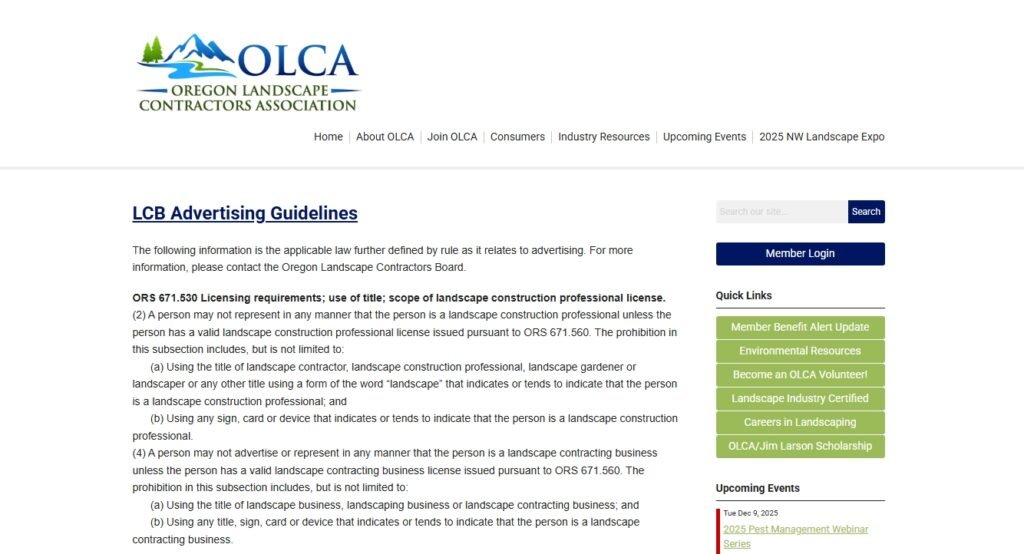
Follow the official website of OLCA for LCB Advertising Guidelines.
4. Business Registration & Other Clearances
Beyond the license itself, you’ll need to get the business side of things set up:
- Registering your business entity with the Oregon Secretary of State (e.g., sole proprietor, LLC, corporation) and making sure your tax accounts (federal IRS, Oregon Department of Revenue) are set up.
- Use the correct business name (or assumed name) and ensure all documentation is in line when you apply for your business license.
- Ensuring all contracts you use with clients meet the required elements of law (for example, scope of work, payment schedule, etc.). The study guides and training material emphasize checking contract elements.
Here’s a Study Guide for Oregon Landscape Contractors License Test.
Why Is It Good to Get Licensed?
Trust & professionalism: Holding the right license says to your clients, “Yes, I’m legitimate, I’m regulated, and I’m licensed by the State of Oregon.” That builds confidence and helps you stand out in a field of handymen or true contractors.
Scope and freedom: Once licensed properly, you can take on bigger landscaping projects (installing patios, irrigation, retaining walls) rather than being limited just to mowing and trimming.
Legal protection: When you’re licensed, you’re following the law (for example, ORS 671.530 prohibits operating without a license). This reduces the risk of penalties, fines, or legal headaches.
Business growth: A licensed business can market itself, bid on larger contracts, get insurance more easily, and generally play in a higher arena.
Pro tip: Even if you only plan to do maintenance work (mowing, trimming, edging) and technically aren’t required by the state license system, check your city or county rules locally because municipalities may have their own business licensing or registration requirements, do check with your city or county.
7. Landscape Association in Oregon
Being part of a professional community can make your journey smoother. Associations connect you with other landscapers, provide training opportunities, and keep you updated on industry changes.
LBD Landscaping: It is one of the finest full-service landscape companies in Oregon.
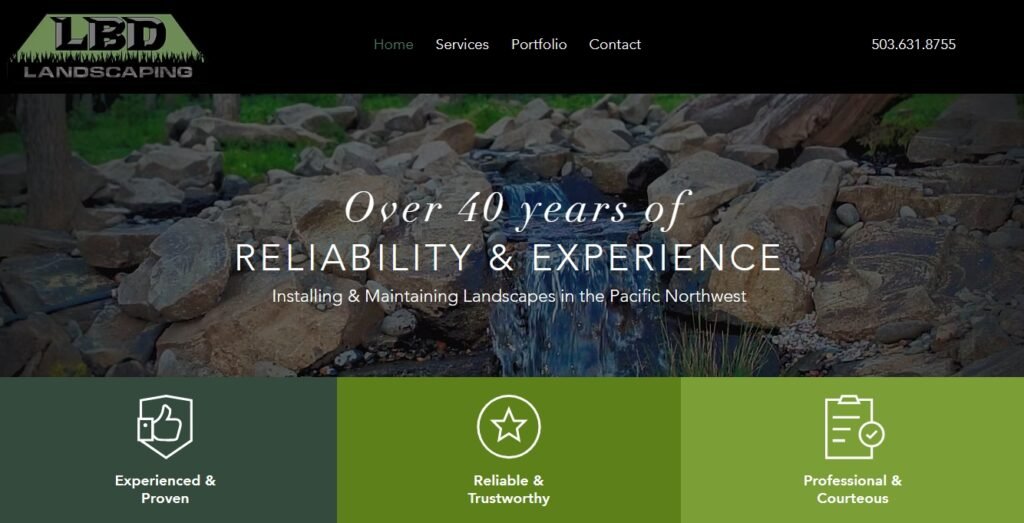
Visit LBD Landscaping for more information.
The Oregon Landscape Contractors Association (OLCA): It is an Oregon’s non-profit organisation that supports and advocates the landscape community at local, state and national level.
Visit Oregon Landscape Contractors Association (OLCA) for more information.